
[ad_1]
Logical fallacies — those logical gaps that invalidate arguments — aren’t always easy to spot.
While some come in the form of loud, glaring inconsistencies, others can easily fly under the radar, sneaking into everyday meetings and conversations undetected.

Our guide on logical fallacies will help you build better arguments and identify logical missteps.
Jump to:
What is a logical fallacy?
Logical fallacies are deceptive or false arguments that may seem stronger than they actually are due to psychological persuasion, but are proven wrong with reasoning and further examination.
These mistakes in reasoning typically consist of an argument and a premise that does not support the conclusion. There are two types of fallacies: formal and informal.
- Formal: Formal fallacies are arguments that have invalid structure, form, or context errors.
- Informal: Informal fallacies are arguments that have irrelevant or incorrect premises.
Having an understanding of basic logical fallacies can help you more confidently parse the arguments and claims you participate in and witness on a daily basis — separating fact from sharply dressed fiction.
15 Common Logical Fallacies
1. The Straw Man Fallacy
This fallacy occurs when your opponent over-simplifies or misrepresents your argument (i.e., setting up a “straw man”) to make it easier to attack or refute. Instead of fully addressing your actual argument, speakers relying on this fallacy present a superficially similar — but ultimately not equal — version of your real stance, helping them create the illusion of easily defeating you.
Example:
John: I think we should hire someone to redesign our website.
Lola: You’re saying we should throw our money away on external resources instead of building up our in-house design team? That’s going to hurt our company in the long run.
2. The Bandwagon Fallacy
Just because a significant population of people believe a proposition is true, doesn’t automatically make it true. Popularity alone is not enough to validate an argument, though it’s often used as a standalone justification of validity. Arguments in this style don’t take into account whether or not the population validating the argument is actually qualified to do so, or if contrary evidence exists.
While most of us expect to see bandwagon arguments in advertising (e.g., “three out of four people think X brand toothpaste cleans teeth best”), this fallacy can easily sneak its way into everyday meetings and conversations.
Example:
The majority of people believe advertisers should spend more money on billboards, so billboards are objectively the best form of advertisement.
3. The Appeal to Authority Fallacy
While appeals to authority are by no means always fallacious, they can quickly become dangerous when you rely too heavily on the opinion of a single person — especially if that person is attempting to validate something outside of their expertise.
Getting an authority figure to back your proposition can be a powerful addition to an existing argument, but it can’t be the pillar your entire argument rests on. Just because someone in a position of power believes something to be true, doesn’t make it true.
Example:
Despite the fact that our Q4 numbers are much lower than usual, we should push forward using the same strategy because our CEO Barbara says this is the best approach.
4. The False Dilemma Fallacy
This common fallacy misleads by presenting complex issues in terms of two inherently opposed sides. Instead of acknowledging that most (if not all) issues can be thought of on a spectrum of possibilities and stances, the false dilemma fallacy asserts that there are only two mutually exclusive outcomes.
This fallacy is particularly problematic because it can lend false credence to extreme stances, ignoring opportunities for compromise or chances to re-frame the issue in a new way.
Example:
We can either agree with Barbara’s plan, or just let the project fail. There is no other option.
5. The Hasty Generalization Fallacy
This fallacy occurs when someone draws expansive conclusions based on inadequate or insufficient evidence. In other words, they jump to conclusions about the validity of a proposition with some — but not enough — evidence to back it up, and overlook potential counterarguments.
Example:
Two members of my team have become more engaged employees after taking public speaking classes. That proves we should have mandatory public speaking classes for the whole company to improve employee engagement.
6. The Slothful Induction Fallacy
Slothful induction is the exact inverse of the hasty generalization fallacy above. This fallacy occurs when sufficient logical evidence strongly indicates a particular conclusion is true, but someone fails to acknowledge it, instead attributing the outcome to coincidence or something unrelated entirely.
Example:
Even though every project Brad has managed in the last two years has run way behind schedule, I still think we can chalk it up to unfortunate circumstances, not his project management skills.
7. The Correlation/Causation Fallacy
If two things appear to be correlated, this doesn’t necessarily indicate that one of those things irrefutably caused the other thing. This might seem like an obvious fallacy to spot, but it can be challenging to catch in practice — particularly when you really want to find a correlation between two points of data to prove your point.
Example:
Our blog views were down in April. We also changed the color of our blog header in April. This means that changing the color of the blog header led to fewer views in April.
8. The Anecdotal Evidence Fallacy
In place of logical evidence, this fallacy substitutes examples from someone’s personal experience. Arguments that rely heavily on anecdotal evidence tend to overlook the fact that one (possibly isolated) example can’t stand alone as definitive proof of a greater premise.
Example:
One of our clients doubled their conversions after changing all their landing page text to bright red. Therefore, changing all text to red is a proven way to double conversions.
9. The Texas Sharpshooter Fallacy
This fallacy gets its colorful name from an anecdote about a Texan who fires his gun at a barn wall, and then proceeds to paint a target around the closest cluster of bullet holes. He then points at the bullet-riddled target as evidence of his expert marksmanship.
Speakers who rely on the Texas sharpshooter fallacy tend to cherry-pick data clusters based on a predetermined conclusion. Instead of letting a full spectrum of evidence lead them to a logical conclusion, they find patterns and correlations in support of their goals, and ignore evidence that contradicts them or suggests the clusters weren’t actually statistically significant.
Example:
Lisa sold her first startup to an influential tech company, so she must be a successful entrepreneur. (She ignores the fact that four of her startups have failed since then.)
10. The Middle Ground Fallacy
This fallacy assumes that a compromise between two extreme conflicting points is always true. Arguments of this style ignore the possibility that one or both of the extremes could be completely true or false — rendering any form of compromise between the two invalid as well.
Example:
Lola thinks the best way to improve conversions is to redesign the entire company website, but John is firmly against making any changes to the website. Therefore, the best approach is to redesign some portions of the website.
11. The Burden of Proof Fallacy
If a person claims that X is true, it is their responsibility to provide evidence in support of that assertion. It is invalid to claim that X is true until someone else can prove that X is not true. Similarly, it is also invalid to claim that X is true because it’s impossible to prove that X is false.
In other words, just because there is no evidence presented against something, that doesn’t automatically make that thing true.
Example:
Barbara believes the marketing agency’s office is haunted, since no one has ever proven that it isn’t haunted.
12. The Personal Incredulity Fallacy
If you have difficulty understanding how or why something is true, that doesn’t automatically mean the thing in question is false. A personal or collective lack of understanding isn’t enough to render a claim invalid.
Example:
I don’t understand how redesigning our website resulted in more conversions, so there must have been another factor at play.
13. The “No True Scotsman” Fallacy
Often used to protect assertions that rely on universal generalizations (like “all Marketers love pie”) this fallacy inaccurately deflects counterexamples to a claim by changing the positioning or conditions of the original claim to exclude the counterexample.
In other words, instead of acknowledging that a counterexample to their original claim exists, the speaker amends the terms of the claim. In the example below, when Barabara presents a valid counterexample to John’s claim, John changes the terms of his claim to exclude Barbara’s counterexample.
Example:
John: No marketer would ever put two call-to-actions on a single landing page.
Barbara: Lola, a marketer, actually found great success putting two call-to-actions on a single landing page for our last campaign.
John: Well, no true marketer would put two call-to-actions on a single landing page, so Lola must not be a true marketer.
14. The Ad Hominem Fallacy
An ad hominem fallacy occurs when you attack someone personally rather than using logic to refute their argument. Instead they’ll attack physical appearance, personal traits, or other irrelevant characteristics to criticize the other’s point of view. These attacks can also be leveled at institutions or groups.
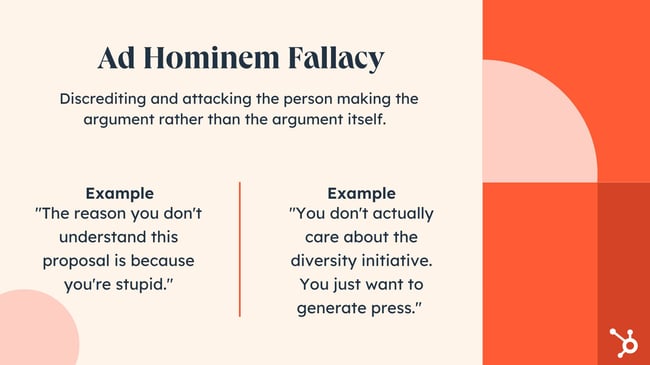

Example:
Barbara: We should review these data sets again just to be sure they’re accurate.
Tim: I figured you would suggest that since you’re a bit slow when it comes to math.
15. The Tu Quoque Fallacy
The tu quoque fallacy (Latin for “you also”) is an invalid attempt to discredit an opponent by answering criticism with criticism — but never actually presenting a counterargument to the original disputed claim.
In the example below, Lola makes a claim. Instead of presenting evidence against Lola’s claim, John levels a claim against Lola. This attack doesn’t actually help John succeed in proving Lola wrong, since he doesn’t address her original claim in any capacity.
Example:
Lola: I don’t think John would be a good fit to manage this project, because he doesn’t have a lot of experience with project management.
John: But you don’t have a lot of experience in project management either!
16. The Fallacy Fallacy
Here’s something vital to keep in mind when sniffing out fallacies: just because someone’s argument relies on a fallacy doesn’t necessarily mean that their claim is inherently untrue.
Making a fallacy-riddled claim doesn’t automatically invalidate the premise of the argument — it just means the argument doesn’t actually validate their premise. In other words, their argument sucks, but they aren’t necessarily wrong.
Example:
John’s argument in favor of redesigning the company website clearly relied heavily on cherry-picked statistics in support of his claim, so Lola decided that redesigning the website must not be a good decision.
Recognize Logical Fallacies
Recognizing logical fallacies when they occur and learning how to combat them will prove useful for navigating disputes in both personal and professional settings. We hope the guide above will help you avoid some of the most common argument pitfals and utilize logic instead.
This article was published in July 2018 and has been updated for comprehensiveness.

[ad_2]
Source link